It's this stuff. This is the plastic netting which is used to hold sod together when it's professionally grown and shipped to landscapers, in order to quickly and efficiently put in a lawn. I always wondered how they could grow grass and then cut it into neat little rectangles to be shipped and laid down in yards, and this is how it's held together, at the root level. With plastic.
This is all well and good until you decide to remove your lawn, in which case you will have to deal with it, as you're killing the grass which keeps it underground and out of sight. In the areas where we killed the lawn, I've had no less than two chickens get their feet caught in this mesh while trying to scratch around, and found one dead snake wrapped in the deadly plastic snare.
I'm afraid I'm going to have to dig down several inches every place the chickens have access to which once had lawn covering it, and pull out the plastic netting to ensure their safety. Yesterday, Cleo (our Aracauna hen) got a toenail caught in some and was probably there for an hour before I noticed her. I also found Valentina with some wrapped around a leg a couple of months ago. Luckily both hens had the brains to just sit down and not struggle, but this could easily have resulted in a broken toe or dislocated leg, both of which might have proven difficult to treat.
In the rest of the yard, we killed the grass and threw down four inches of bark on top of the dead grass and plastic netting, which means that while the grass will decompose, the plastic is still there, hanging out and not decomposing for 500 years. Should it ever become un-buried in the decades to come, it could easily trap wild birds, toads, snakes and even larger mammals such as foxes or coyotes. Once wrapped around a foot or toe, it quickly cuts off circulation, so even for a good sized animal it could quickly become a problematic and possibly even fatal issue.
I predict (and fervently hope) that as more and more folks start taking our their lawns in these parts, the outcry over this eco-hostile netting will cause someone to come up with a biodegradable version, which won't last beyond the lifetimes of our great-great grandchildren, as this plastic will. In the meantime, we will always be sure there are several good inches of bark covering ours, and pray any future homeowners will do the same.
This is one of those cases where you say, "there has GOT to be a better way."
Rant over. Carry on.
Our summer project of killing half our lawn is already off to a good start. As you can see, much of it is brown and the good news is, everything that is brown is what we WANT to get rid of. In other words, the lawn we are keeping is staying green and the lawn we're removing is dying nicely. Some more will die as the summer wears on, but we're off to a really good start.
In a way it bothers me to kill a healthy lawn; that is the farmer in me whose job it is to keep things green and growing whenever possible. But sometimes having to kill something is inevitable. I do not smile when I see my dead lawn, instead I tend to look down at those moments and remember why it is that I have to kill it: It's so we can plant some appropriate plants in the space, or add additional patio area. It's also so I'm not throwing good drinking water on a crop that provides nothing for us but something to look at and walk on. And most importantly, it's because if everyone is cutting back -- and even if they are not -- using less water during a drought is the right thing to do.
 |
| A time to die. |
Any good farmer or homesteader should have trouble with killing living things; the day it doesn't bother you is the day you need to pack it in, buy a condo in the city, and seek the services of a professional therapist, because taking pleasure or just not caring about the times when you have to be a participant in the taking of any life is just, well, creepy.
I find when I have to kill something, whether it's a plant or a creature, I go down little checklist in my mind. Question One: Is the killing necessary so that something else may live or so that something does not suffer? Question Two: Is there a better way to accomplish this rather than taking said life? If the answer to #1 is yes, or the answer to #2 is no, then I know what I have to do. But truthfully, there isn't a spider, ant trail, chicken or patch of grass I don't run through the aforementioned checklist with before commencing with killing it.
Thankfully today it is only part of a lawn that has to die here, and I can honestly look forward to the things that are going to take its place. But no matter what, I am cognizant of the fact that as the homesteader here on this particular patch of land, part of my job is deciding what lives and what dies. It's a responsibility I hope I never take lightly.
Here's an ariel shot of the domestic end of our homestead -- our house and yard. Our acreage is off to the left side of this photo and can't be seen in it, but it's there, just down the hill beyond those trees.
If you see the highlighted areas in the image, that represents the second portion of lawn we will be killing and getting rid of this summer, as part of our back yard renovation plan. As you can see, the front yard has already had its lawn removed and drought-tolerant landscaping has been put in.
So if we took out half the lawn in putting in our front yard landscaping, raised beds, and chicken coop/run on the right side of the house, this new project will remove about half of the half that's left. Meaning in three years, we've taken out 75 percent of our water sucking, useless, non-edible lawn, which should bring us to a point of well exceeding the State's mandate that we reduce usage by 25 percent, due to the current drought.
I'd love to take out even more, but we are leaving a bit of lawn on the back and side of the house, first because we can't landscape over our septic tank, and second because we plan on having a fire pit and want to be able to apply the sprinklers to it if it's ever necessary, since it's rather close to the house.
So I'm already excited, dreaming of what's going to go onto those highlighted areas -- more Spanish lavender, more red hot pokers, and more ceanothus, plus some other natives I've been wanting to try -- including milkweed, main food for the lovely Monarch Butterflies that live around here part of the year. Plus a larger patio area for entertaining. Who says water conservation can't be beautiful?
And the best part is that easiest phase of the project comes first: shutting off the water in those zones, sitting back and letting the summer sun bake the unwanted portions of lawn into dead, yellow straw, which we can then just landscape over.
And then the creative planning and real physical work begins, probably next winter.
All part of moving things forward in a (very) dry land.
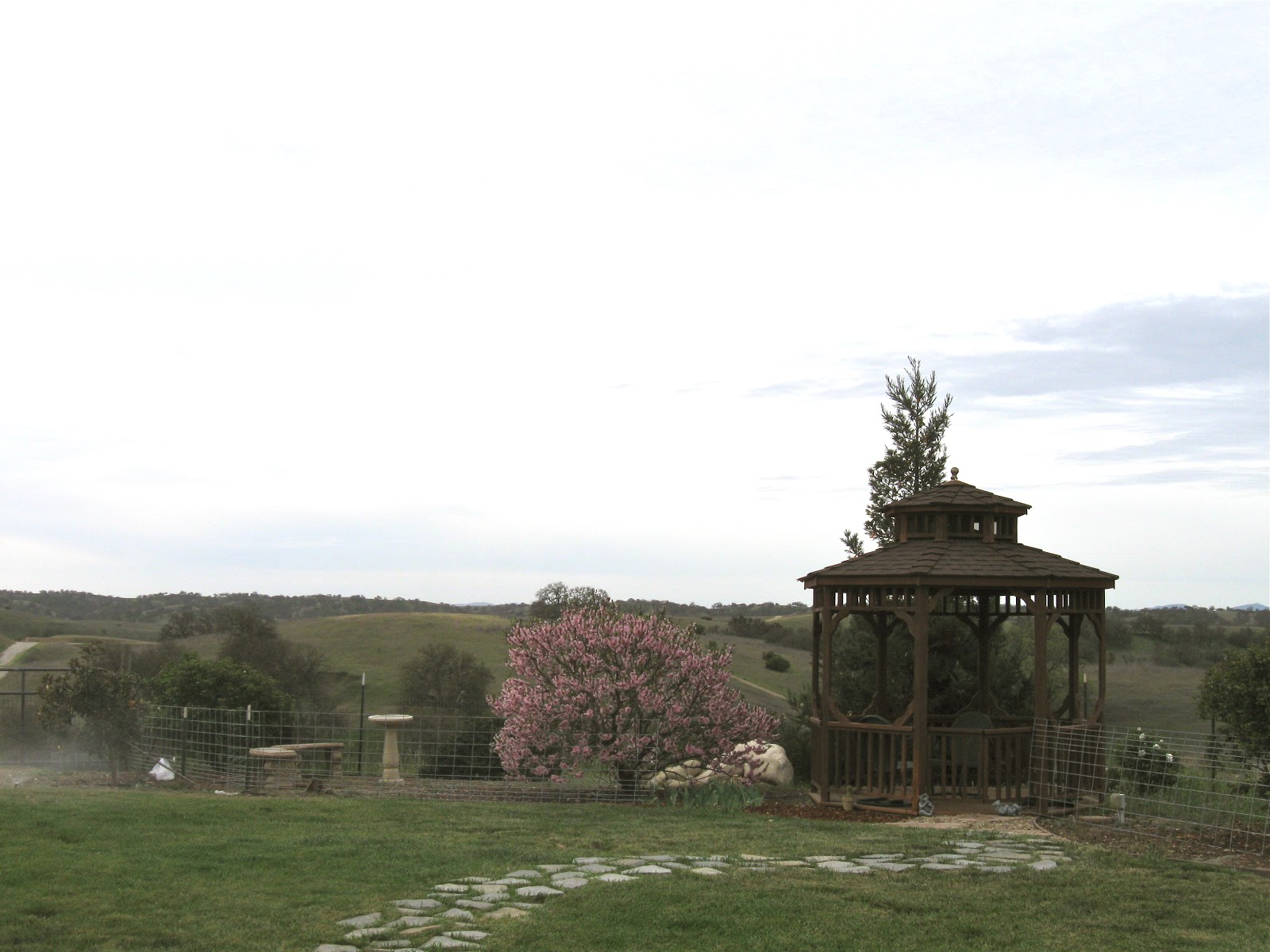
So what's a cloudy day like this good for? Not rain. Nope, on this dry but cloudy day, I'm running the sprinklers (which is happening in this picture, if you look to the far left). Over the last couple of days I've noticed our last stretch of remaining lawn in the back yard has taken on a definite yellow-ish cast, indicative of a lack of water.
It's only March, which in a normal year would usually mean our watering schedule would still be set for winter....a 10 minute sip of water, once a week, just to cover any dry weeks between storms. You don't usually dare do more than that, because those regular rainstorms provide more than enough potential water to soak your yard nicely. But in this very dry year, that 10 minutes weekly is just not cutting it, so last night I adjusted the watering schedule on the timer to water longer and more often. And with a long stretch of clear weather in sight, it looks like we're going to be headed into a very, very brown and dry summer.
It's not a good sign.
While one or two dry years won't change the fate of our world, a longer period would. Steve, the owner of the winery we like to frequent, was telling us a couple of weeks ago he's already had to start up his wells to water his vineyards, which means him, us and all our neighbors are all taxing the aquifer a little more than normal in this dry year. And in an area of falling aquifer levels, that's never a good thing.
The other problem is the mineral content of our well water, which is high. In a municipal area, you'd just call it extremely hard water, capable of clogging your pipes and making your glassware opaque. But in agriculture it's different. Every year, this area counts on some good, drenching rain to remove the built-up minerals from the soil and wash them away, so the rain deficit is a problem here, too, as plants don't grow as well in soil with mineral build-up.
The only bright spot is that, with so little rainfall, the brush around the area has not grown up as green or as thickly as it sometimes does. This means that we probably have a lower wildfire risk than usual. But unfortunately, it also means that some wildlife, like deer, will have a harder time finding forage.
But since it's a little late for enough rainfall to bring our totals back to rainfall, we'll just push through and look towards next year for some better rain totals.