Showing posts with label planting. Show all posts

Wednesday, May 29, 2019

Renting vs. Owning


So what are your feelings on the rent-versus-own dilemma? With home prices steeply rising before leveling off at the end of last summer, as well as higher interest rates, many people who could own are now opting to just rent instead, indefinitely. 

Home ownership does, after all, come with a lot of surprise costs (you often don't realize something like a stove or an HVAC system is failing until it falls over dead). There's also a lot of regular maintenance, which coincidentally, did not get done on this current house and which allowed us to knock thousands off the asking price, meaning you can pay for it now, or pay for it later -- your choice.  But you will pay. 

Renting, on the other hand, provides a lot of freedom from responsibility but very little security; you can be asked to vacate your home in 30 days by your landlord, for a variety of very legal and valid reasons which have nothing whatsoever with the fact that you've been a great tenant. 

Living in and renting a company house for a year, we debated renting versus owning a lot. I was actually pretty happy renting since we had room for the chickens and raised beds and the freedom to do pretty much whatever we wanted with the place, but Big Ag hated renting. He wanted a place he could own outright. So he never really settled in there, despite having his dream barn/shop. What I didn't realize is that I hadn't really settled in, either. 


I know this because now that we're homeowners again, things feel completely different. I can't tell you why, but it just feels more like home. The things you laugh at in your rental, like outdated fixtures, you check the budget on in your owned home to see if you can afford to change them. It's like dating versus marriage. There are marriage deal-breakers that we all probably think are amusing and interesting in someone we're having coffee with, like having a pet python or finding out they painted all their bedroom walls black. But is that person marriage material? Oh hell no.


What's funny for me is the amount of old household habits that have come back now that we're in our own place again. I just made a batch of soap last week, we have two new raised beds installed, all ready to go for vegetables this summer, and I planted one of the raised beds over the leach field with sunflowers, hollyhocks, gladiolas, peonies, and zinnias. I've also been working on the front yard landscaping, just adding a few plants I miss from California and which also grow great here in Oregon, like rosemary, English lavender,  and Russian sage.


I had four raised beds in the rental that I never used, and plenty of chances to make soap if I'd wanted to. So why didn't I? Probably because of some subconscious feeling that I just didn't want to do things that would make me feel committed to settling in there. Coffee was fine. Marriage was out of the question.  


Perhaps it really does matter whose name is on the title deed. There may be a deeper level of settling into a place that only comes when you know it's yours -- when no one can ask you politely (or otherwise) to leave. 

And I'm sure "settling in" means different things to different people, but settling in is definitely what we do when we're home. 

And we are home.


Friday, April 7, 2017

The birds

How I used to feel in my spring garden.

This spring has been different in one very substantive way...I have not had to fight either the wind, the birds, or the insects in my garden. Right now there are potatoes, carrots, lots of lettuce and some spinach growing, which will mean a bountiful harvest until about June I would guess.


It's been so lovely to pass by the lettuce section of the produce department every time I visit the grocery store without needing to purchase any, after a couple of years of frustration in trying to grow it.


This year, it's different.

The trick, it turns out, is shade cloth. I will fully admit stealing my inspiration for this new addition from my friend Beth, who showed me her garden last year nestled under its white canopy of shade cloth. Seemingly free of insects and certainly not damaged by wind or birds, all her crops looked beautiful and I got a serious case of crop envy.


And so this year, I installed the row cover supports and put everything except the potatoes and onions under wraps. And it worked. 


Munched! A lapse of judgement -- no shade cloth -- quickly rectified.

I know all this made a difference because this morning, with a rainstorm coming in, I put in some spinach transplants, and figured a couple of hours without a cloth cover wouldn't make much difference in bad weather. The birds wouldn't be out and about, right? I was wrong. When I went back out the winged criminals were fleeing the scene, after picking apart one spinach transplant completely, and probably getting ready to move onto the others. And so, in the middle of the rain, I covered the rest of the spinach and left the birds to find forage in our pasture.


It may have taken me five years to figure out, but I think I finally understand the rules to growing here: grow it under wraps.

Saturday, March 19, 2016

Two Hats

"Man with two hats" sculpture in Ottawa, Canada.


So this month I've been wearing two hats at the winery; still finishing up in the tasting room (I am on the schedule until the end of the month) and also beginning to work on the Chef's Garden in preparation for planting in another week or two.

I've also commandeered our sunroom here at home to be a de-facto greenhouse for the first things I will be planting -- squash of all kinds, which are a staple on the summer menu at the winery, and also tomatoes, cucumbers and edible flowers like nasturtiums and calendula. Plus I've planted seeds for fall squash like butternut and pumpkin, which need to go in the ground in early May. Can you believe we already have to start thinking of fall? I only just dragged my short sleeves out of the closet again.

But while I'm dancing at two weddings as well as taking master gardening classes (and BTW our last class was all about grafting apple trees, which I discovered I suck at -- who knew?), posting will be a bit light. I'm sure that by the first week in April things will become a little more normal again. On April 1 I'm also having some minor surgery on a benign tumor that's been bothering me for awhile now -- it's been pressing on a nerve on my hip -- so it's not an exaggeration to say I'm really looking forward to being down to ONE job and having a pain-free hip again. It's the little things in life, ya know?

Endings and beginnings are rarely clear-cut and obvious in most areas we give our time to. Usually one thing winds down as another is winding up, and so you end up with periods of double this or that. In this case, double employment. At least both my jobs are at the same wonderful place, which I'm thankful for.

So I will be light on word count for a couple more weeks but I'm going to try and make up for it by posting more pictures.

Tomorrow we will be attending a wine dinner and I hope to share that with you. It's a huge festival weekend in Paso Robles and all the wineries are doing something. It sure will be nice to get out and have a Date Night with Big Ag.

Wednesday, February 24, 2016

Volunteers

There are several humorous online tests you can take for OCD (Obsessive Compulsive Disorder) and more than a few funny memes to test yourself and see how bad you are, like this one:


If this irritates you, you may have a few (or a lot) of OCD tendencies. But here on the homestead another good gauge of OCD is how (and what) you do with your property's volunteer population -- those plants you had nothing to do with buying or seeding -- which just show up one day, usually in a funky place where they do not belong or fit in.


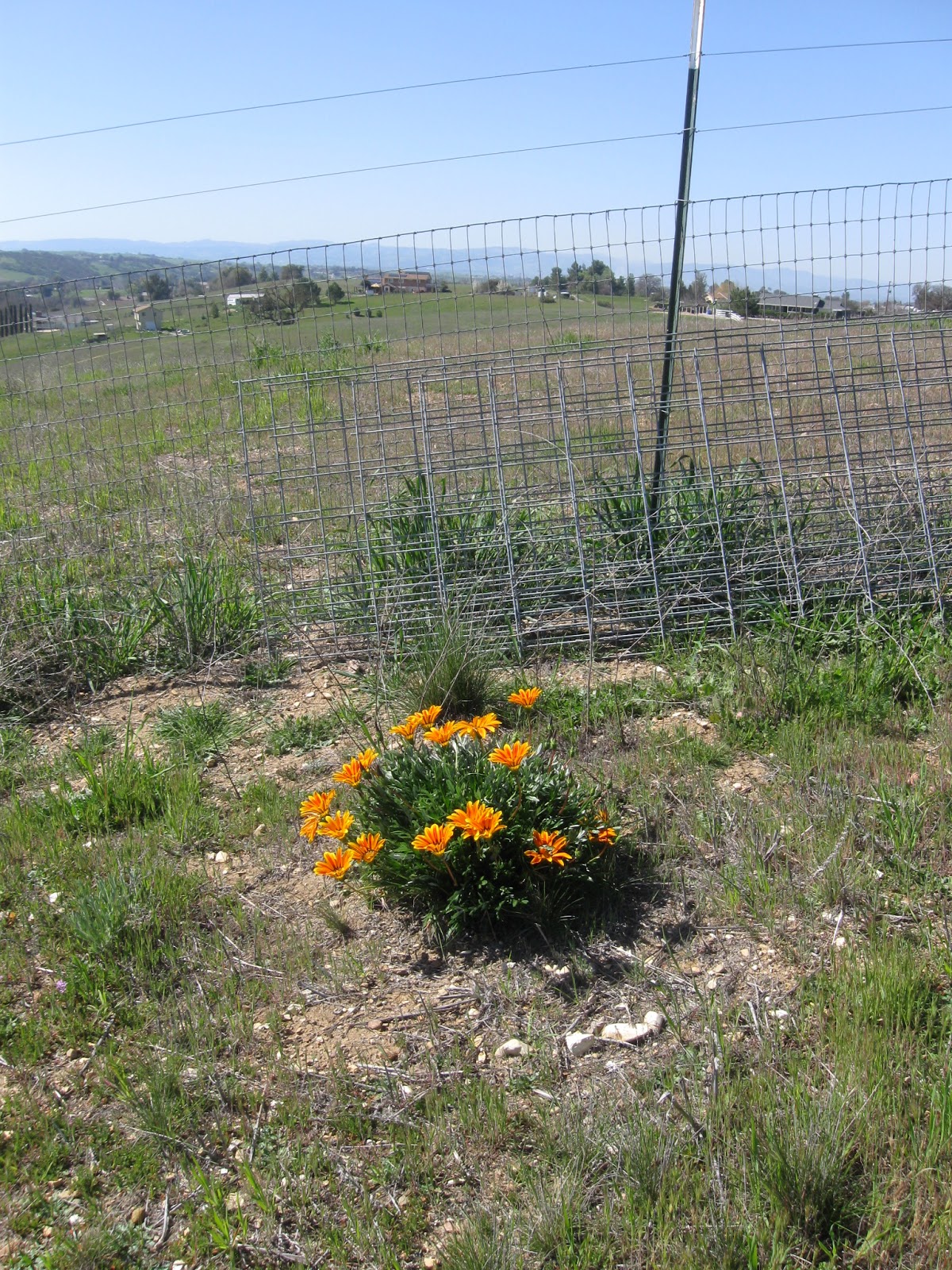
This gaillardia, for example is so stunning I am dying to move it to a place where it can be shown off, rather than where it currently sits in our pasture. But since it looks like this with absolutely no supplemental water and has been here for as long as we have, I am afraid if I try and move it I'll sever the tap root that's probably keeping it alive. I'm sure if we ever get livestock I will fence it in or borrow a tractor to dip deep and bring it up, but for now I get to enjoy it every once in awhile when I am down pruning berries or weeding.


These coyote bushes showed up in the exact spot you see them in, when we killed the front lawn (intentionally) the first summer we moved in, as we prepared to plant some drought tolerant plants. I decided to leave them in and they are now two massive, oval-shaped shrubs, which do require shaping but little else (including water). And both the birds and bees absolutely love them, so I'm happy to allow them to stay. True, I had to do my landscape design around them, but to have two such mature-looking plants in the yard after only three years was worth some revision.


These baby coyote brush plants (above) will be transplanted up to the top fence line of our property, where we plan on having a privacy hedge. One thing I can say about coyote brush is that while many of our neighbors remove it as soon as they see it, we use it.  Free native plants, right?


And this little tomato somehow withstood all our winter freezes and is planning on blossoming soon. This is perhaps our most important volunteer, because through its survival, I now know we have a significant warm microclimate in this spot in the yard where it may be possible to grow citrus. So thank you persistent tomato plant. 


Wednesday, January 27, 2016

January spring


It's early spring here on the homestead. Around the central coast, we generally get a long spring and long summer, and late January is generally when we start seeing our first hints of spring. Fall and winter are both extremely brief, which people either love or hate, depending on their general temperament. I'm in between, loving the long spring but hating the long summers. And missing a good fall every year. Someday we will retire and do something about that, but for now, there is plenty here to love. And it seems appropriate to have a lot of green inside, too, to match what's outside.


Anyway, even though the first almond blossoms are starting to appear and the hills are turning emerald green, you don't dare plant anything yet, as frosts and even freezes are still probable.

If summer is the time to be inside in the air conditioning (while all you midwesterners and easterners are outside loving the sunshine and your garden) then late January and February is the time of year for us to be out and about outdoors. It's cool enough to work (65 degrees F this week as a high temperature), sunny enough to be pleasant, and a great time to get things done before the heat comes. Because it's coming. Of that there is no doubt.


Today I pondered what's going to go into my big raised stone flowerbed, other than irises and milkweed. Such endless possibilities! Building this wall was very easy. Now we just have to add the back and fill it up with good soil.


I added some beach pebbles to the metal agave plants and their colorful pots. Decided the gazing ball belonged with its similarly colored siblings, the pots. So now I have some color and interest where I needed some but did not want to add any more plants.


Found this Enrico Coveri scarf at Goodwill for $1.75. Score. Wore it to work last week at the winery and got tons of compliments on it.


We have salads galore and have been using a dressing of Mandarin Orange Oil and Fig White Balsamic to go on them from our local olive oil company, Olivas de Oro. So delicious and refreshing. I planted some more lettuce and spinach this week to keep the greens coming.

All in all, it's been a lovely January spring so far.


Sunday, January 24, 2016

Another brick in the wall


Today we are working on the raised bed which will house my irises, milkweed and assorted annuals. This is going to be a focal point of color in the back yard, and we've therefore decided to build a raised bed for it all, using blocks. In the pic above (to the right), you can see the poor irises and some agapanthus struggling in the crappy soil that is our hilltop.


Big Ag is doing the first level, which involves the kind of precise leveling I do not have the willpower for ("it looks close enough" is pretty much the grand theme of my life), but after the first level of blocks is finished, I will be able to do the rest myself. 

I'm excited to get the irises out of the place I stuck them when I moved. It has very poor soil and is under constant threat from gophers as well, so getting them into a secure garden bed (there will be chicken wire under the planter) will bring a good feeling, and of course with spring coming planting some annual color will be fun.

Garden Art, for art's sake.

We've also invested in some pottery and I snagged two metal agave plants at the last auction, planning on using them in the yard. These are the kinds of finishing touches that are always the most fun to do, and I'm really looking forward to adding some interest to the landscape by the pottery elements and annual color.

I'm thinking of putting this big ball in the center of the raised bed. What do you think?


The voice in my head (our marker for the septic tank) said it wanted its own ball. Who am I to argue.

Tuesday, December 8, 2015

Bringing home the color -- update!


So I've come to the most fun part of the back yard landscaping project, which is picking out the plants to adorn the growing space! For us, this is the perfect time of year to plant, as it's temperate and not hot enough for the plants to get shocky when placed in the ground. And since it's supposed to be 70 degrees this afternoon -- perfect planting weather both for me as well as the plants -- I think a trip to to the nursery is in order.

I already did a diagram of how I want this section of the yard to look, ran the drip lines, etc, and so it's just a question of finding the plants themselves. I've picked drought-tolerant, easy keepers which will be a pleasure to look at but don't need a lot of work, since my work efforts are mainly centered in the vegetable and fruit growing areas of the property. 


The only plant here which requires some vigilance is the Yellow Broom, which tends to get moths laying eggs in it and then hatching, thus destroying parts of the plant. I will have to be sure and put on some bacillus thuringeinsis (BT) spray on a regular basis in the summer months to ensure I get my yellow flowers...but I think yellow flowers are worth it.


I also bought four milkweeds about a month ago, with the idea of using them in this section of the yard -- but after seeing the constant problem they have with aphids (and you can't spray them with anything other than water if the Monarchs are going to use them) I've decided they will go in some side areas where their looks will not be so important. What with old age encroaching, perhaps I should probably find a space like that for myself as well. Just put me on the side where you can't see the imperfections unless you're really close up. Ah, with plants as with life, yes?


And I'm ordering two rose bushes as well -- after the holidays, so I don't have to go down to the post office and wait in a long line of Christmas package senders and pickers-up. I'm going for one "Barbara Streisand" hybrid tea rose, which is a gorgeous lavender (to complement the blue agapanthus and lavender plants, plus the purple crape myrtle tree) plus a "Good as Gold" yellow/gold rose for an accent color. 


Since I was five years old, I've known that there's nothing better than going to the nursery to buy plants. Talk about a gift that keeps on giving, especially appropriate during this time of year.


Update: Here it is all set out in the yard, waiting to be planted...Provence lavender, foreground, couple of yellow brooms, salvia, penstemon, agapanthus and one very nice Italian buckthorn, which was a whim kind of purchase. I think it adds some nice variance in color from the natives.

I feel like I'm in the home stretch, but that's because I'm ignoring the fact that there is 9 yards of bark I have to order and move into place. Denial is SO convenient sometimes!


Tuesday, June 2, 2015

Peace if you want it.


There are a lot of advantages about living the homesteading lifestyle.  I love the way the hours shift with the seasons in particular. In winter we have things set up so that I rarely have to venture outside to the business end of the property before 7 a.m. because it's too cold and dark to effectively get much done, and in summer I try and be DONE with my farm chores by the same time, meaning I will rise and start work at about 5 a.m. once the days become long, which is about now.

In this area (and it's what makes this region great for wine grape growing) there is a huge diurnal shift in temperatures -- the morning that starts off at a brisk 50 degrees can easily morph into a day where it's in the high 90s by noon. Some climes stay warm all the time in summer -- there are balmy midnights and temperate dawns, but we are not one of those places.  If you are going somewhere after dark, you will need a sweater or jacket -- maybe two. And so it just makes sense (if you have any sweat-producing tasks to complete) to rise early and get started before the sun even makes an appearance on the horizon because it's just so much more comfortable to work in cooler weather (this is the hot flash homestead, after all).

Today my 5 a.m. task was finally getting around to tilling a spot where our pumpkins are (hopefully) going to be growing. I threw some bagged soil on top of the tilled spots, enough to make three mounds, where I then placed my seedlings.  Since I'm starting this whole project about a month behind when it should have been done, I also used some white shade cloth to keep the seedlings cool for the first week or so, until they're a little more acclimated to their new spot. 
Undercover pumpkin patch.

And then, around 8 a.m. with the fog lifting and the sun making his first appearance of the day, the world was warming and my chores were done.  It was a good feeling.  And I sat down there in the garden on my little plastic chair and just enjoyed the peace surrounding me. There was no wind, and no sounds other than the occasional chirp from a hummingbird and the sounds of bees at work among the plants. 

"Peace" is a noun, I have realized, just like the words "shovel," "eggplant," and "house" are. And just like those things, peace is something you can pick up and enjoy/use, or just leave it be. You have to consciously decide to attend to peace, to observe peace  and to use peace, just like any other object in your life. Otherwise it will sit quietly on the sidelines like an unused tool, never crying out for lack of use or really even letting you know its there. It IS there, of course, all the time.  But it doesn't demand its place in life the way other things in life do. Use it and it's a tool to make your life better. Don't use it and it sits out in the garden, always there, just unnoticed, like an old spade or garden hoe left in a corner. The bees buzz, the hummingbirds chirp and whiz around the bushes, but no one is there to notice. Peace exists even when you are not there to notice. And so the trick is to do so.

Peace is possibly the most valuable crop, garden tool, and place to shelter out of all the things we think about on a day-to-day basis. This morning, after finishing my chores I consciously picked up peace and held it in my gaze for awhile.  And I'm glad I did.


Saturday, May 2, 2015

Cycling Through

Here on the Central Coast (and probably in other places where weather unpredictability is the name of the game), you learn to go with the weather patterns rather than fight against them.  We had our first heat wave of the spring season last week, with temperatures hitting the 90 degree mark.  It was also the week my cucumbers, which I grew from seed, were due to be planted. No go. Instead, I moved them outside into a shady spot to acclimate and held off on planting.
Can't wait to get these cukes in the ground. Mama needs relish.

Our weather tends to come in waves or cycles, and this week was a heat wave.  We also get "wind waves" which are possibly even worse for young plants than heat is. Most places around the country get "cold snaps" which are extremely cold temperatures which are temporary in nature. We get those sometimes, but extreme heat is usually what Mother Nature chooses to "bless" (!) us with.

And it all runs in cycles, for everyone. There are small cycles, such as heat waves/cold snaps, and larger cycles, such as drought/rainy cycles and possibly completely new cycles occurring due to global warming.

Success in growing things means learning to flow with the waves and snaps, not fight against them, whatever their reasons. It's, literally, the same thing as waves on the beach.  Fight the waves and the waves will always win.  Go with the waves and you can usually navigate within them to find your way either out to sea or to the shore, wherever you need to be.

I'm not saying to necessarily lay down and accept climate change without taking political action.  But in the garden, you can't fight it without losing your crop, so best adapt to what's happening and just get on with it. That also gives one a sense of productivity instead of helplessness. Work with what's happening and do what you can with what you have.  There's peace of mind to be had within that, whatever is going on.

So next week will be the time for planting not only my cucumber transplants, but also getting some pumpkins and summer lettuce started, because of course the heat wave also sent my spring lettuce into bolting. But next week the heat cycle breaks for a few days and we'll have seasonal temperatures once again.

In other news, one GOOD thing about the heat wave was that it gave us an advance start on killing most of our back lawn and kicked our baby squash plants into high gear.  Less water on the lawn means a bit more can be applied to the food crops. So, again, working with what's going on rather than against it, the heat does have at some advantages.

Global warming may NOT mean a world covered in water, but instead.....giant squash!?!


Monday, April 21, 2014

Chopped

I don't watch cooking shows on television, but a friend of mine said I should watch a show called, "Chopped," because it reminded her of how things happen at our homestead.

Basically, on "Chopped," someone in charge apparently brings in a random set of ingredients to a chef and they have to create an appetizer, main course, and dessert from what's there.

Today, whoever is in charge here (this would be a toss-up between God, chance, and Mother Nature) provided this:


Carrots, radishes, peas, and eggs.  My idea is to make Egg In The Hat with some Ezekiel bread and some eggs, serve the radishes as an appetizer, and sautee the peas and carrots together as a side dish.  I also have some lettuce in the fridge from the garden, so I'll make a side salad, too.

If we want dessert, I guess a souffle or some vanilla ice cream would be the way to go, since we have more eggs than anything else.

Do you have "Chopped" days, where you get a strange set of ingredients and have to make a feast from it? It seems like the norm around here.

Sunday, April 6, 2014

Planning for Failure

This afternoon, I planted three Ichiban eggplants which will hopefully grow and provide us with lots of great dishes this summer.  Last summer I had three Ichiban eggplants and we were literally swimming in eggplants.  I'm pretty sure I composted and give away more than we ate.  Clearly, we had too many eggplants.

So why did I choose again to plant three eggplants?  Simple.  I always plan for failure.

You can bet that, should I ever actually cut down my initial grow to just two or even one eggplant, something will happen to them and I will end up with less than I need, or worse -- none.  That's virtually guaranteed, with Murphy's Law being what it is.

And so I choose gross excess over deprivation, which would be bad, if it were anything other than vegetables.  Hard to argue that too many veggies are bad.

Wednesday, March 19, 2014

The climate calendar


Every climate zone and geographical region has its own calendar, and in my opinion it takes at least one year of living there to figure it out.  Even within what a map will tell you should be one climate zone, there's a difference between what folks in a valley of that area can do, versus those who live on hilltops. It's a totally individual thing, based on your own property, which is why it takes awhile to learn.

Right now, for instance, we are hustling to finish re-fencing a few parts of the property, put in a few additional landscaping plants on the west side of our back yard, and add/remove drip irrigation where it's needed, or not. We are striving to have all this done in the next month or so, because around May, the temperatures can sometimes get too hot to do much except water, and you'd better have your drip system already in place and working by that time or you'll be standing outside in the heat with a hose at least once a day, twice a day if its over 100 degrees.  

It doesn't always happen that way, but it can, so you have to plan your tasks around the climate year and what it's reasonably expected to produce in terms of conditions.

And the "push" here involves getting things done due to physical limits on what you can reasonably do in the heat, more than anything else. In other parts of the country, there's a similar push, but it happens in the fall....to finish projects by first snowfall, so you're not out working and trying to complete projects with a couple of inches (or feet) of snow on the ground.

And so we work with our yearly calendar, with dates marked only in our minds, as the time when we know it all needs to be done so we can retire to the shelter of the house.  It's one of the advantages to staying in a homestead for many years, as you learn over time when the winds come, what conditions bring out the aphids, and when to plant tomatoes if you want to start harvesting in July instead of August.

For us, there's a slim window for spring tasks --  a time between when wind has finally dropped but when it's not yet too hot to plant. We're approaching that window soon, and so I expect the next 8 weeks will be busy ones in the garden.

One of the things I love about this life is that our reliance on the calendar is not so much the calendar of days, but the calendar of seasons. Windy season, frost season, heat season.

What about you?  When are your "busy zones" on the calendar of seasons?

Monday, February 10, 2014

Landscaping

Big Ag and I decided to spend this weekend working on the property, weeding and removing some zombie butterfly bushes.  Why "zombie" you say?  Well, because they weren't quite alive, but also not completely dead.  

They were also huge.  Which meant we needed to use his Jeep and his winch to pull the plants out.  

This was a win/win, because Big Ag loves to play around in his Jeep, and I love the times when that useless, several-hundred-pounds-of-decaying-yellow-metal hulk can do something useful, other than adorn our driveway with its persistent oil leak and rusting parts. 

I am talking about the Jeep right now, just to clarify that.  Big Ag does not leak oil (yet).

Anyway, I now have two empty holes in the ground, which means I can do some plant shopping.  This will not be edible landscape I'm looking for, but rather something that will benefit the wildlife in the area, specifically butterflies, bees and birds.  So one hole is going to get a cottonwood tree, and the other will get some kind of native, flowering plant or flowering small tree.  

I think it's important that, along with feeding ourselves, we also feed the winged creatures that rely on the nectar and protective covering that some types of landscape can provide.  It's important to share the land. So this is definitely a project that will be pleasurable to do, and I can't wait to see something green and growing in the space where the zombies once stood.


Thursday, March 7, 2013

Spring crops are ready to go!


Yesterday I checked at our local ag extension office to see what the last hard frost date is in our area and discovered, much to my surprise, that it was a couple of days ago.  As I've said since we moved here, this first year is a total learning experience.  I am learning everything from the ground up (literally) and finding out the frost ends this quickly here was something of a surprise, but a nice one.

This means its relatively safe to start plants outside that are a bit frost tolerant, although I wouldn't plant anything outdoors considered truly sensitive (like tomatoes) for several more weeks, just to be safe.  But everything I have gathered here should be OK to start. 

The dish you see is where my heirloom tomato seeds are germinating, which will remain indoors for another six weeks or so and the warm weather arrives to stay.  This is, by far, the best method I've used for starting tomato seeds.  You take a moist paper towel, lay down your seeds on it, and then cover it with another moist towel.  Within a few days (if you keep it moist and don't let it dry out) you will see exactly which seeds have germinated, and you can then plant those in pots and let them grow until they are big and hardy enough to go outside.  There are also some bush bean seeds germinating in the same way in the other room.

The other seeds will pretty much be directly sown in the raised beds we have, and I will take whatever I get.  I am hoping to get in a nice spring crop before I need to begin starting the serious summer plants -- zucchini squash,  crook-neck squash, the tomatoes of course, and cucumbers.  But I still need plenty of carrots and spinach, as I freeze those crops for use in things like casseroles, vegetable dishes and stews, which we eat throughout winter, so I'm hoping to get them in  and get them harvested and out of the ground by about June.

It may be raining outside, but I'm feeling a strong case of early summer here indoors.  

Saturday, January 5, 2013

Planting an orchard


Today we are planting our orchard on the south side of our property.  We have a variety of fruit trees suitable to this climate, and are hoping everything takes off this spring.  Whatever does not will be replaced, until we have a full complement of trees in that area. There is something immensely satisfying about beginning to put this land of ours to good use. I was totally intimidated by it when we moved in here this summer.  I would go outside and look down at it all, then quickly avert my eyes towards something that seemed more....workable.  Like a small bed for my irises, perhaps. But in the last seven months or so, this land and I have gotten acquainted, and it's finally no longer scary to plan out what we want to use it for. I like permanent crops because they require no tillage and few soil amendments, so they allow the majority of our topsoil to remain in place, but of course there are lots of other uses for it as well, since we have almost two acres.  


We've pretty much decided that half what we've allotted for growing space will house fruit trees and the other half will house vines and berries (yum!).  The rest of the acreage will be split into thirds and we will graze goats, sheep and possibly even beef on it.  We'll seed it so we have healthy grasses to crowd out the weeds, and use fencing and rotational grazing to make sure our animals don't overgraze the whole thing, as has happened with so many of our neighbors around here (especially those who keep horses.  I've learned nothing is as tough on native grasses as free-grazing equines).  And as we're on a hill, we need to stay mindful of erosion and the possibility of mudslides.

It feels so rewarding to finally be putting this land to what I really feel God called us to do with it.  We're responsibly stewarding it.  As Deuteronomy 8: 7-9 says, "For the Lord your God is bringing you into a good land, a land of ...vines and fig trees and pomegranates; a land of olive trees and honey."

All those apple pies, peach cobblers, blackberry pies and homemade wine definitely make this a good land, to be sure.