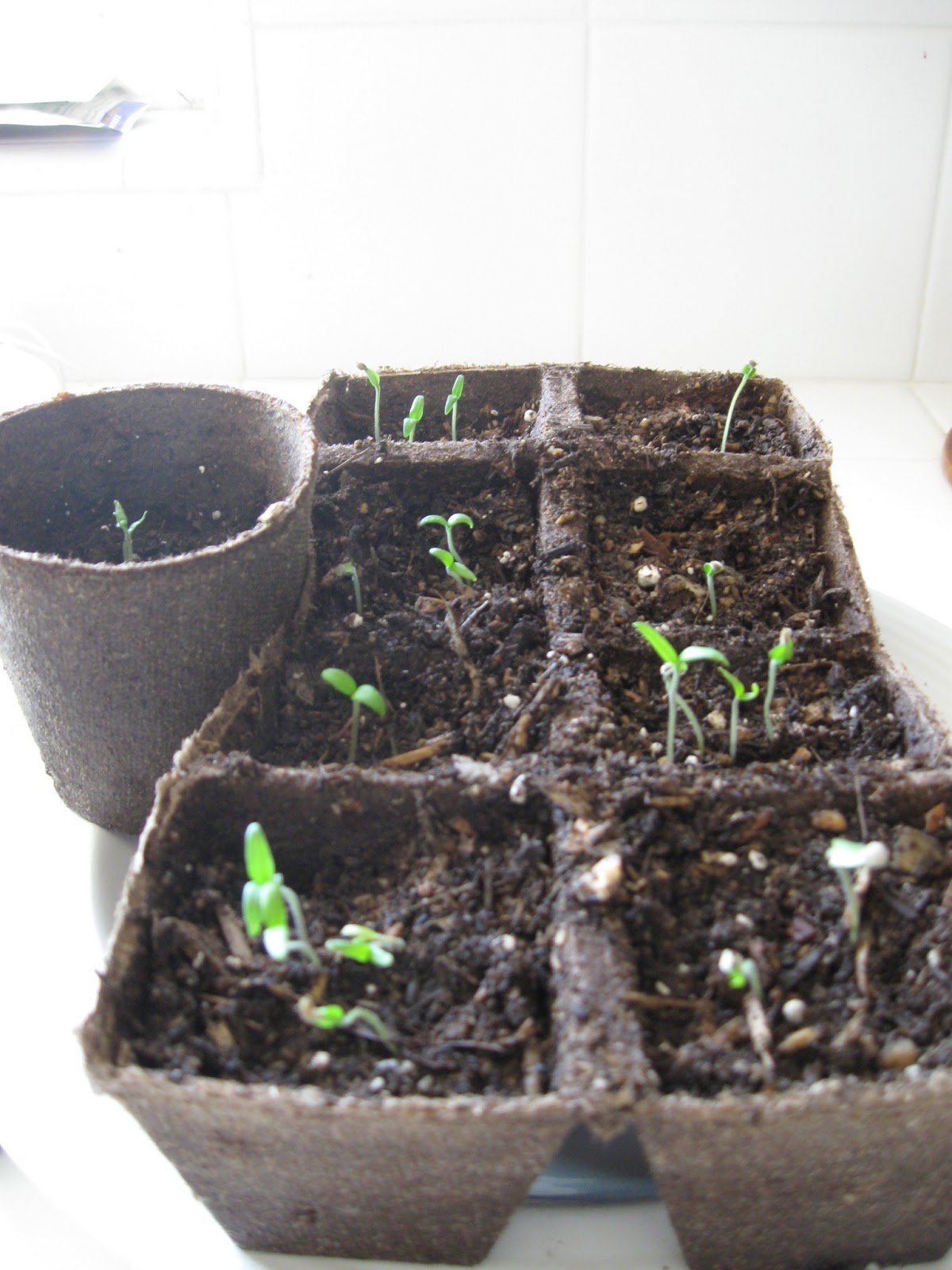
These are the starts of some new Pink Lady heirloom tomatoes, to replace the ones I lost in the windstorm a couple of weeks ago. I bought some other varieties of heirloom transplants at the nursery as replacements, but was crushed to think I was not going to have any Pink Ladies on the table this summer, as they are the best tomatoes I've ever eaten or canned -- meaty, flavorful and HUGE.
But the grower at the nursery insisted it was NOT too late in the season to plant some more seeds and get my Pink Ladies back, in time for at least late summer picking, so last week I placed some seeds on a moist paper towel, covered them with Saran Wrap, and waited. Even though these seeds are two years old, they still sprouted, faithfully! And yesterday I was able to take the seedlings and put them into some potting soil.
These babies are going to be spoiled and pampered, waiting until they are fairly large to go into the ground. I'm not losing a crop again. I'm not even particularly concerned with how many tomatoes they produce this year, only that I can again save some seeds from just one tomato and have many more Pink Lady tomatoes next year, when I will be wiser about waiting to place them in-ground.
In a related story, I was at a Daughters of the American Revolution meeting last week and spoke to our registrar, who is an avid gardener. Her advice? Put nothing in the ground before May 1. She said between the possibility of frosts/freezes and windstorms, planting before then is a gamble. The gal at the nursery said the same thing, so there seems to be some consensus there.
Well, I learned that one the hard way, but at least I did learn. I am not so much deterred as determined.
From the paper, "Preserving Seed Diversity," possibly the best reasoning I've seen yet to preserve heirloom trees and vegetables by planting them wherever and whenever possible:
Heirloom seeds are incredibly important for the genetic diversity of agriculture. Commercially produced seeds of big agriculture, though high yielding and pest resistant, are genetically uniform and are helping to fuel what Cary Fowler, director of the Global Crop Diversity Trust calls a “mass extinction”. According to Fowler, In 1880 farmers in the United States were growing over 7,000 named varieties of apple and since 6,800 have gone extinct. This is not exclusive to apples, over 100,000 varieties of wheat exist today, but many are in danger of being lost “not in the same way you lose your car keys…losing it in the same way that we lost the dinosaurs,” simply because ease of industrial agriculture relies on uniformity. That uniformity can only be achieved by having genetically identical plants growing at the same height and ripening at the same time. Heirlooms have grown to be locally specific varieties, possessing resistance to the pests alongside which they evolved. The varied genetics often produce interesting colors and shapes as well as more intense flavors. Since heirloom varieties are not focused on easy mechanical harvesting or large fruit to stalk ratios, the plants themselves are larger and have larger leaves leading to an increase in photosynthesis and an increase in sugars produced for the fruit.
To real the entire article on the Food Security website (a clearinghouse of information and resources prepared by the students in Professor Kathleen Morrison's Spring 2012 course, "Food Security and Agriculture: Calumet" at the University of Chicago), follow this link:
http://foodsecurity.uchicago.edu/research/preserving-seed-diversity/